Showing posts with label pork. Show all posts

Monday, October 27, 2014

Uncommonly good

Red-braised pork
Hello, friends. It’s been a while, ages, really. I’ve had my hands full trying to sort some things out. Most of it has had to do with my dissertation. It’s taken me the better part of a year to undo some of the habits and thinking that were holding me back, making me miserable. So, now, writing bits and pieces of it is not quite the terrible thing it once was. And that has opened up my days some. There has been more time for friends and cooking and soaking up the sun. I’ve been in a good place, and I hope that things can stay this way.
Last month, I was in China with my parents for a few weeks. I won’t say much about the sights, though, because, really, this trip for me was about family—the long hours I spent with my mom on the bus, gazing out at the passing scenery (yaks, looming peaks, haphazard fields of tomatoes hugging the winding, narrow mountain roads) and talking quietly, the morning we spent at an open market in Huanlong Valley, threading through the crowds and munching on sweets like the ones my mom grew up with, the last afternoon in Guangzhou when all of us, even my dad, who doesn’t do any of the cooking at home, gathered at the table and fumbled with dumpling wrappers, trying to imitate my uncle’s deft hand movements. It had been years since I’d spent this much uninterrupted time with my parents and almost as long since I’d seen many of these members of my extended family. And though, of course, we got on each other’s nerves occasionally (okay, maybe more), the time we spent together left me feeling closer to them than I have in a while.
Mis All in
I’m not very good at sustaining relationships at a distance. I let the more immediate demands in my life pull me away. And it’s always been especially difficult with my parents, I think. I’ve grown into a person very different from them in a lot of ways. So, there isn’t always a whole lot to talk about from week to week. But having spent so much time with them recently, I’ve been determined not to let things lapse. And as became obvious to me during the trip, the easiest way to do this will be to talk about food.
It’s not as though my mom and I didn’t talk about cooking before this. But up until I started cooking from Fuchsia Dunlop’s books last year, most of what found its way to my table wouldn’t have been anything my mom could’ve related to. During the trip, however, we all talked about food a lot—about the produce we saw at markets, about the cooking methods behind dishes served to us at restaurants, about the greens I was growing back home and what I might plant next year. Cooking more Chinese food—even if it wasn’t exactly the kind of food I’d grown up with—had given me a way of connecting with my family that I hadn’t quite had before.
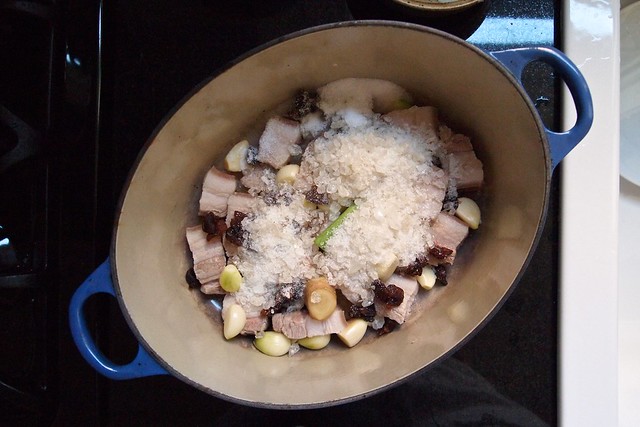
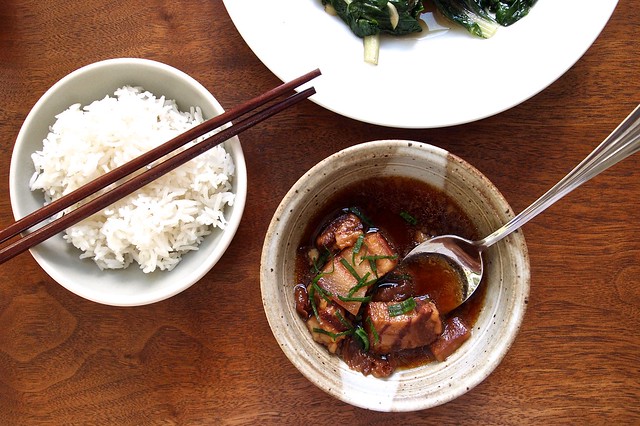
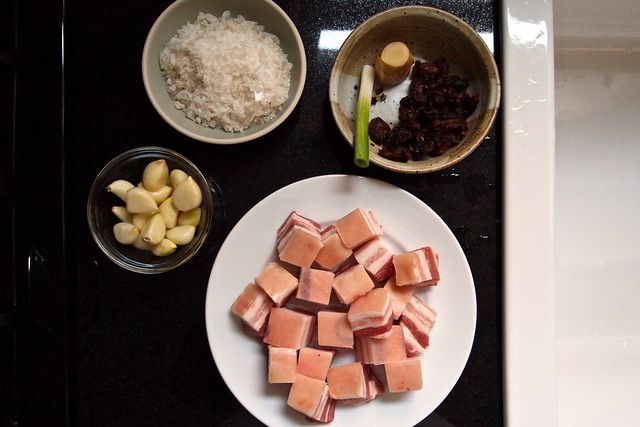
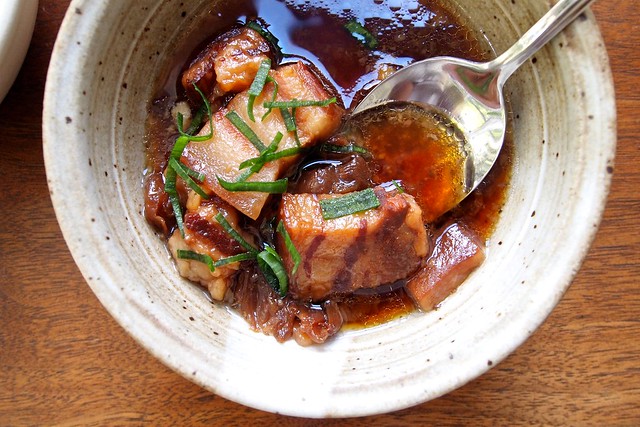
So, I’ve been trying to do more Chinese cooking since getting back. The dish that’s really stood out since then is another from Fuchsia Dunlop—her red-braised pork with garlic. This dish might be a hard sell for some of you. But I think it’s incredible. You start with a one-pound slab of pork belly. You cut it into one-inch cubes and set these in a heavy pot along with whole garlic cloves, rock sugar, ginger, scallion, Sichuan peppercorns, and dried longan fruit, with water to cover. Then, you cook it all at the barest simmer for ten hours, at the end of which the pork belly pieces are translucent, unctuous, and uncommonly good—a whole-mouth luxury. 
Now, the thing that you might hesitate over is the pork belly. There is no way around this: it is mostly fat. To be clear, I’m not usually one to shy away from animal fat. But I tend to think of pork fat as something to cook things in—not as the thing to be eaten. So, even I blanched a little when I unwrapped the parcel from the butcher. There was definitely more fat than muscle on this slab. This dish was seeming like less of a good idea. But I was wrong about that. You want all that fat. The long cook transforms it. It takes on the flavours in the pot and becomes something delicate and meltingly delicious. 
Another close-up
Of course, it is still fat. But that’s okay. Red-braised pork is meant to be enjoyed just a morsel or two at a time. Cover the rest of the table with vegetable dishes and gather some friends around. That, anyway, is what I’ll tell my mom when I talk to her about it. (Even if lard was the choice fat for cooking when she was growing up, she has never quite embraced animal fat in the way I have. So, I’m not sure that I’ll be able to talk her into cooking this dish.)

Red-Braised Pork with Garlic
From Fuchsia Dunlop in Lucky Peach no. 11
Note: About the longan fruit. I’m not sure about how widely available these are in North America in their dried form. I coincidentally was given some by a family friend while in China. Dunlop says that you can substitute dates or just go without. About the rock sugar. Rock sugar is a common ingredient that you can find in Chinese grocery stores. It’s less sweet, and possibly less refined, than conventional granulated sugar. It’s sold in large chunks, which you are supposed to break up yourself at home. I’ve found that a mortar and pestle are the best tools for the job. Pound away at it, and it’ll eventually start breaking up.

450 g pork belly with skin
3 heads garlic
1 small piece of ginger (about 25 g), unpeeled
1 scallion
165 g / 3/4 cup sugar, preferably rock sugar
45 g / 1/4 cup dried longan fruit (pits removed)
1 tablespoon sea salt
8 Sichuan peppercorns

Bring a medium pot of water to a boil.
Meanwhile, break up the garlic into cloves and peel them. Use the flat side of a cleaver to crush the ginger and scallion slightly to release their flavours.
Cut the pork into 1-inch chunks. But do not cut it along its vertical axis—it’s okay if the chunks end up longer on this axis. You want each morsel to have a bit of skin and then layers of fat and muscle underneath. (It’s these together that make for the most delicious bites!)  Drop the pork into the boiling water and blanch for about a minute. Drain in a colander and then rinse with cold water.
Place the pork and all the remaining ingredients in a heavy-bottomed pot (clay or cast-iron) that will fit them all in a single layer. Add just enough water to cover. Bring the liquid to a boil over medium heat, then cover and cook over extremely low heat for 10 hours, by which time the pork will be fall-apart tender and the garlic will have melted into the sauce.
Before serving, remove and discard the ginger and scallion. Garnish with more fresh scallion if you wish, and serve with plain steamed rice.
Serves 4-6 with other dishes.

Thursday, May 9, 2013

In-between days

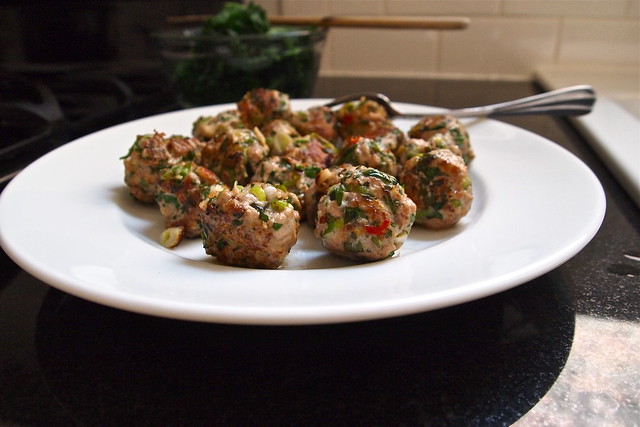
Pork balls in broth
Around here, spring tends to come in dribs and drabs--a splash of sunshine here, a smattering of blooms there. It takes a while for the season to gather momentum, to really come into its own. In some ways, these first few weeks are the ones I like best. The first shoots out of the ground, the first lacy blossoms on the trees--spotting these on walks around the neighbourhood makes me want to skip to the end of the block. Spring! It's here! It's here! There's something so good about the newness of it all. 
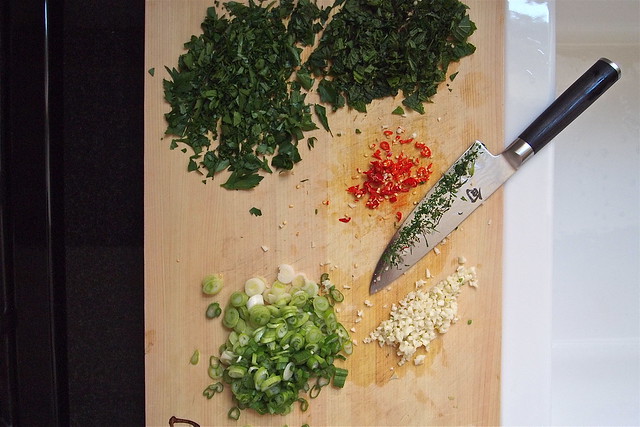
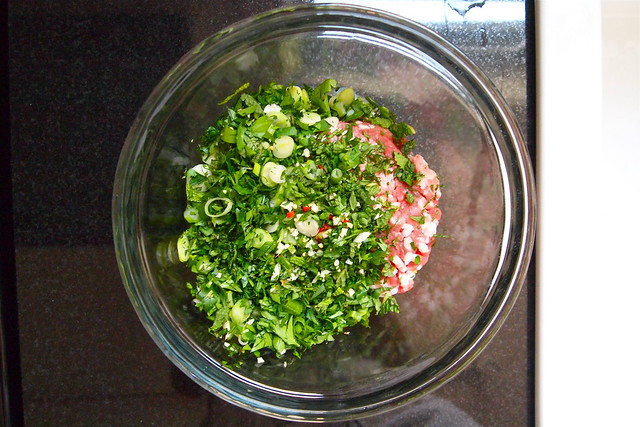
Mise for the pork balls Chopped For mixing
But like I said, the season's momentum is slow to gather. Like right now, it feels just about like spring. It's warm enough to throw open all the windows, and when passing through the yard, it's hard not to crush a few violets underfoot. They've got it carpeted. But most of the farmers' markets in town have yet to open, and even when they do in the coming days, it might be a while before there's much more filling the stands than asparagus and pea shoots (which is not to say that I have anything against either). So, yes, I'm being impatient. But after months and months of brassicas--roasted, braised, and pan-fried--how can you not be? There comes a point in the year, however short-lived, when it's hard to even look at another cabbage.
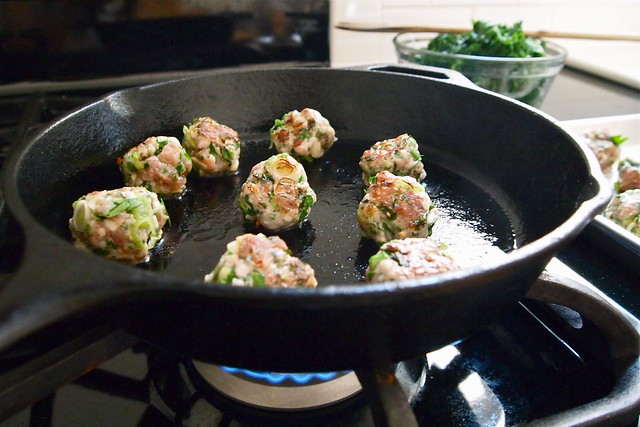
Fry up Pork balls Bowls
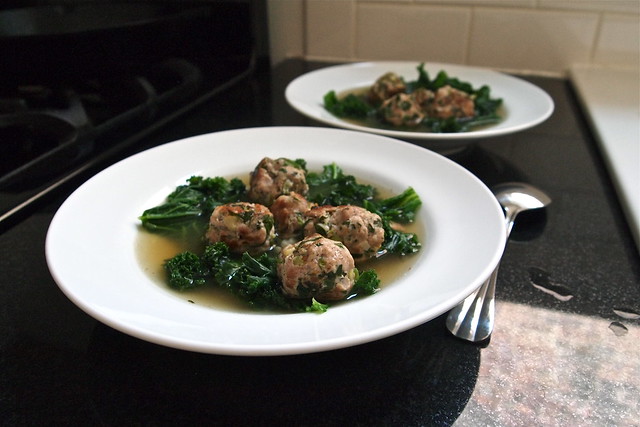
But, in these in-between days, cabbage is what you can count on. So here is something to help you wait out the days--Nigel Slater's chicken broth with pork and kale. Now, I can't go so far as to say that it tastes like spring--that would just be a bit of a stretch--but it doesn't quite recall the depths of winter either. An in-between kind of dish. For, though that ruffled kale afloat in broth has an unmistakable wintriness to it, the meatballs do not. These are rolled together with generous handfuls each of parsley, mint, and scallion, as well as a bit of fresh chile for kick, then seared golden in a hot pan and finished in the broth. The effect is something bright and fresh, something powerfully enlivening--enough to slough off the last of winter's drabness and make you forget (at least for a little while) that you are waiting.
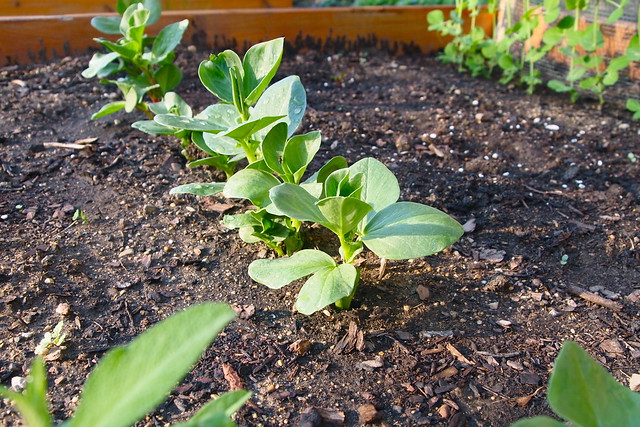
Germination!

Chicken Broth with Pork and Kale
Adapted from Nigel Slater's Tender
Note: As Slater says, you can substitute the kale leaves for savoy cabbage, and I get the feeling that I might have preferred it that way. I also bulked up the leftovers the next day with some cubes of boiled potato, which rounded things out rather nicely.

PORK BALLS
400 g / 14 oz ground pork
2 small, hot chiles
4 scallions
2 garlic cloves
6 bushy sprigs of parsley
6 bushy sprigs of mint
1/2 teaspoon fine sea salt
A little vegetable oil

SOUP
1 liter / 4 cups chicken stock
125 g / 4 1/2 oz kale leaves (from about half a bunch)

Remove any tough stalks from the kale leaves and tear into rough pieces. Bring a medium pot of salted water to a boil and blanch the kale for a minute or two, then drain and set aside. Give the pot a quick rinse.
Put the pork in a mixing bowl. Finely chop the chiles and add them with their seeds to the pork. Slice the scallions, discarding the roots and the very darkest tips of the leaves. Peel and mince the garlic, and add with the scallions to the pork. Pull the parsley and mint leaves from their stems and chop coarsely, then add them to the pork with the salt. Mix everything thoroughly with your hands and form into about sixteen balls, about 1 1/4 inches in diameter.
Warm a thin slick of oil in a cast-iron pan and cook the pork balls, in batches if needed, until toasty on all sides, about 5 minutes.
Meanwhile, in the same pot the kale cooked in, bring the stock to a boil and season with salt and pepper. Lower in the pork balls and then decrease the heat and simmer for 5-7 minutes, until they are cooked through. Add the kale to the soup and serve immediately.
Serves 3-4.

Monday, February 18, 2013

You have to engage

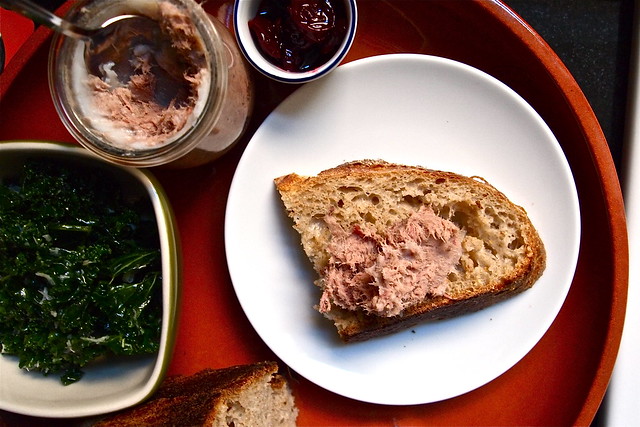
Smoked ham hock rillettes 
"We're sensorily deprived right now in modern life. Our eyes are engaged--sometimes our ears--but our bodies? Not so much. These aren't just bags of bones we're carrying around." -- Michael Pollan in Lucky Peach no. 6.
Smoked ham hock rillettes. This one might be a hard sell, not because making a few jars is particularly difficult but because--there's no point in trying to hide it--it's messy and time-consuming, a real process as far as a recipe goes. You cannot but get your hands (and your kitchen) dirty. But that's also what I enjoy about making them.
You might roll your eyes. Grad student. Too much time on her hands. But that's not what this comes down to. On weeknights, I'm all for ease and convenience, for meals that practically cook themselves and hardly leave a trace. But those aren't the meals that draw me to the kitchen. They're not the reason I cook. I cook to engage myself, to use my hands, to make messes and learn a thing or two in the midst of making them. These aren't, of course, the most basic reasons for being in the kitchen, but they are the ones that make cooking a pleasure, whatever night of the week it may be. And it's good, I think, to remind ourselves of this once in a while and cook something demanding, something that draws us in. And these rillettes, they do that.
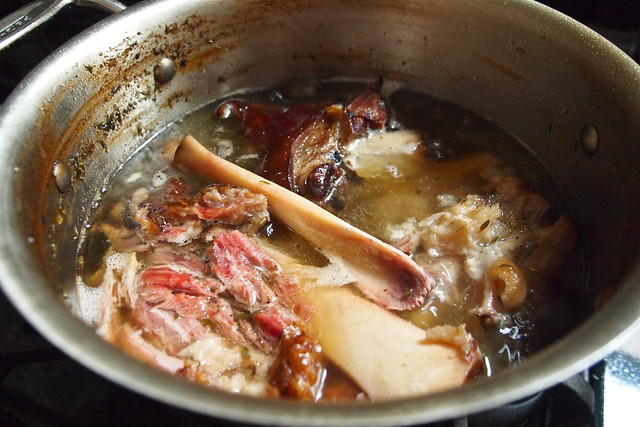
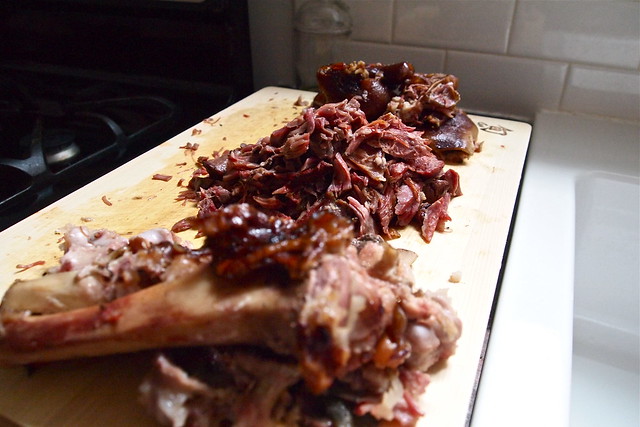
Smoked ham hocks Ham hocks near the end of cooking Ham hocks broken down
Rillettes traditionally are a coarse-textured, rich spread made from a fatty cut of pork, duck, or goose. The meat is gently braised, finely shredded, and then mixed with fresh herbs, spices, and the flavourful liquid in which it was braised. Pretty straightforward. The result is something like pâté but less fussy. These particular rillettes, however,  come from the good people at Mission Street Food and so, unsurprisingly, part with tradition. 
The hock is pretty lean as far as cuts of pork go. In fact, it's mostly skin, bone, and connective tissue. So that's where things start to get messy with these rillettes. Once the hocks have been cooked, you need to get at what little meat there is. And there's no getting around this, you need to use your hands. Bits of  meat are often tangled up with connective tissue and hard to spot, so what you need to do is break down the hocks by hand and feel your way through them, pulling soft tissue from bone, picking out the meat as you go.
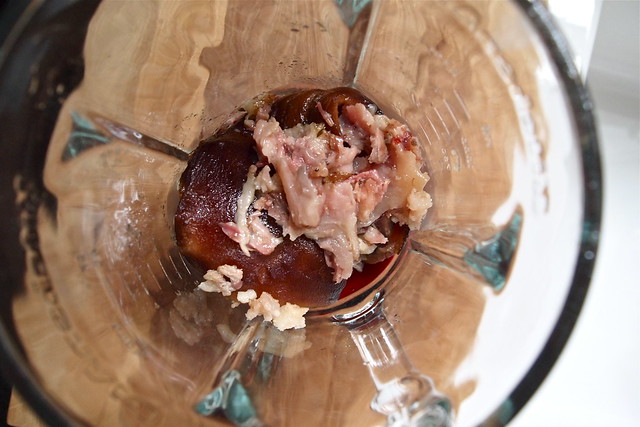
But why use smoked hocks in the first place, why go through all that trouble for so little? Because what smoked hocks lack in flesh and fat they make up for in flavour and collagen. Remember all of that skin, that sticky connective tissue? Even after four hours of simmering, these are still steeped through with woodsy, smoky flavour. And just as important, they're rich in collagen. Collagen is all about texture. It's basically what gelatin is made out of. It's the stuff that gives homemade stocks their satiny, rich mouth-feel. So, naturally, that skin and connective tissue don't go to waste here. You whirl them in the blender with a splash of stock from cooking the hocks and push that through a sieve. And there you have it, smoky gelatin purée.
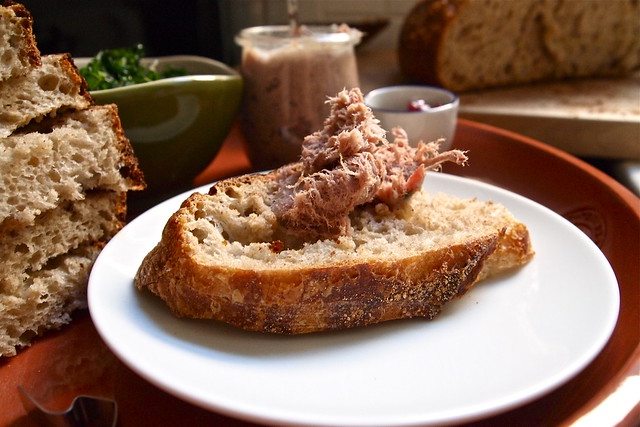
Skin and connective tissue Components collected Rillettes on sourdough
Now, this, I think, is where things get demanding. It isn't that anything gets difficult. It's just that your attention, your judgement is called for. You have to engage. Let me explain. At this point, you'll have all of your components lined up. From the hocks, you'll have meat, pork stock, and gelatin purée. You should also have some rendered pork fat (yes, lard) on hand to supplement what you have, since ham hocks are so lean. Then there are the seasonings. Quatre épices, a blend of white pepper, nutmeg, cinnamon, and clove, is traditional. Crushed garlic, dijon mustard, sherry vinegar, and fresh thyme leaves aren't out of place either. Salt, needless to say, is important. (As printed, the MSF recipe is loosey-goosey. Very helpfully, it calls for 'spices'.) The meat goes into the bowl of your stand mixer fitted with the paddle attachment. What happens next is more or less up to you. Each of the components will contribute a particular flavour and/or texture to the finished rillettes. How you prioritize them is a matter of preference. What this means is that you have to taste and tweak as you go. You have to ask yourself: does this need more fat? Is it getting too dry--should I add some stock? Could it use more acidity, more vinegar, maybe? Like I said, you have to engage. And little by little, you'll get to something that pleases you, that makes you beam.
So what I like about making these rillettes is that it's very physical, very involving. It's all about you feel and what you taste. This is no dump-and-stir exercise. There's no crossing your fingers, hoping that things have turned out. How things go is on you. It's a little scary, for sure. But it's also utterly liberating. I don't cook like this very often. I lean a lot on good cookbooks, regimented quantities. And on most days, that's all I feel I have the time for. But once in a while, I think, this is just the sort of thing you need to do.

Smoked Ham Hock Rillettes
Adapted from the Mission Street Food Cookbook
Note: About the seasoning. I stuck with fairly traditional seasonings, but you shouldn't feel limited to these. Look at other rillettes recipes for guidance. It'll be hard to go wrong. For example, I flat-out forgot to add mustard. My feeling is that juniper might be a nice addition. About the pork fat. There's no need to spring for anything as fancy as leaf lard for these rillettes. Save the good stuff for pies. But do take the trouble to find yourself some good, unprocessed fat. Try your favourite butcher. About the quantity of hocks. I got away with using just over 3 lbs of hocks but only because one of them was extra meaty. It would probably be wiser to use closer to 4 or 5 lbs. Shelf life. Sterilizing your jars will help the rillettes keep for longer in the fridge. Both Nigel Slater and Jane Grigson advise pouring a layer (half an inch or so) of melted pork fat over the rillettes if you're not planning on eating them within a few days.

3-5 lbs meaty smoked ham hocks (see above)
2.5-3 quarts chicken stock, pork stock, dashi, or water
1-2 cups rendered bacon or pork fat, plus more to cover (see above)
2 tablespoons or so sherry vinegar
1 tablespoon thyme leaves
1 1/2 tablespoons or so quatre épices
1 large clove garlic, crushed
Salt

Gently simmer the ham hocks in the chicken stock, pork stock, dash, or water.
After about 4 hours, the meat should be very tender. Cool the entire pot until you can handle the hocks. Drain and reserve the stock. (At the end you'll have plenty of stock left for cooking greens, or just for sipping.)
Pick the ham hocks apart by hand. Separate the meat from the skins and soft collagen. Reserve both. (The edges of the ham hocks can become dried out and tough from the smoking process or from not being fully submerged in liquid. Move the hocks around periodically as they simmer, and discard any parts that may be too tough to rillette. Discard any tough skin, bones, and weird gristle.)
Blend the skins and collagen with just enough stock to get the mix going (probably about 1/4-1/2 cup), creating a gelatin purée. Strain the purée through a fine sieve, using a lade or spoon to push it through.
Combine the meat and some of the purée, fat, vinegar, and spices in a stand mixer. (The ratios of fat-to-meat-to-gelatin will vary, depending on how you prioritize richness (fat), unctuousness (gelatin), and moisture (stock). Taste as you mix; add the salt, vinegar, mustard, and your spices, herbs, or garlic until you reach the desired balance.) Mix using the medium-low setting and the paddle attachment of your mixer. For best results, mix the rillettes at the temperature it will be served.
Store in glass or ceramic jars and chill in the fridge until ready to serve. Serve with good bread, pickles, a sharp salad, or even some tart fruit preserves. Consider stuffing any that remains in baked potatoes, as Nigel Slater suggests.
(In addition to the ham-hock stock, there'll be lots of leftover gelatin purée, which you can use to enrich anything from meatballs to gravy. If you're not quite ready to jump into another meat-centric project, it's okay to freeze the purée for later use.)
Serves 12-16 as an appetizer. (Fills about four 200 g jars.)

Thursday, January 10, 2013

It's not always about looks

Smoked pork hock
A smoked ham hock is one of those items off a hog that will never win any beauty contests. It comes to you still wearing its skin, now dark and leathery from the smoker. Sometimes, a few wiry hairs still jut out from the skin, a reminder of its provenance. A thick bone protrudes from its centre, making it obvious that there isn't much to it but bone. I was more than a little intimidated the first time I freed one of these from its butchers' paper. I just wasn't sure that I wanted it in my pot, especially with that hair. Did this thing really belong in a cooking pot? (The one pictured above is a much nicer-looking specimen than my first hock. Hair-free too.)
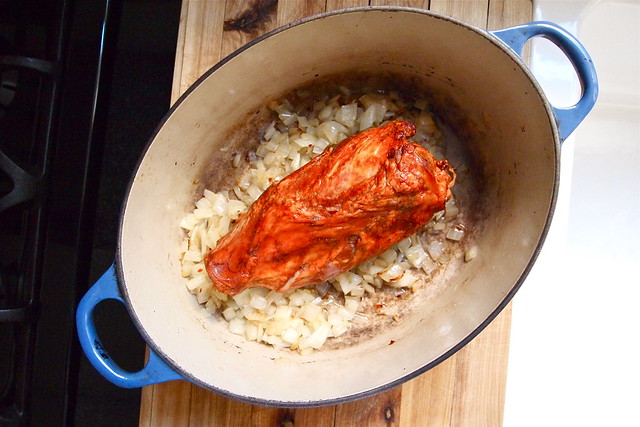
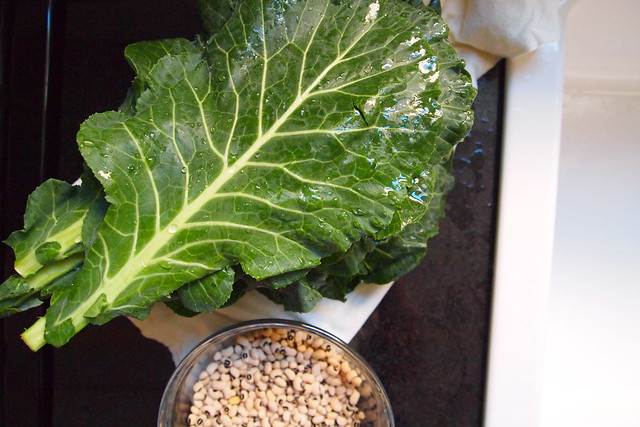
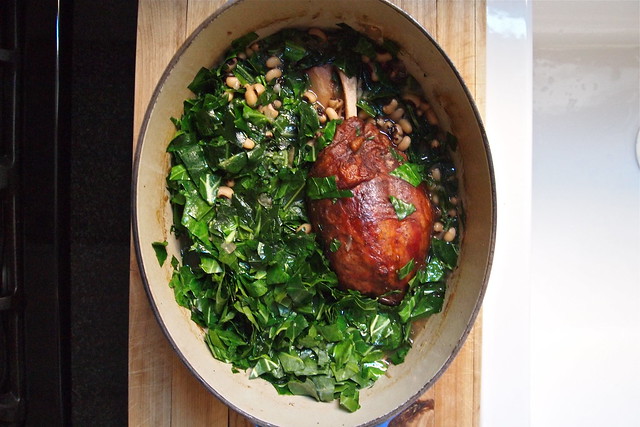
Ham hock and onions Collards and black-eyed peas Collards and the hock
But I quickly came to appreciate a smoked hock for what it was. It isn't always about looks, you know. See, a smoked ham hock is an ingenious thing. The hock is the cut from a hog's hind leg between the foot and the ham proper. Unlike the ham, there isn't much meat to the hock. It's mostly bone, skin, and tough connective tissue. And what meat there is is pretty lean. For these reasons, it's not a much sought-after cut. It takes a little work to get to a hock's goodness--a long, low, simmer. So the smoking is one way to make it worthwhile. As a smoked hock breaks down in its cooking liquid, it gives off a lot of flavour--smoky, porky, woodsy flavour. Like I said, ingenious.
Now, maybe early January isn't the best time to be extolling the virtues of pig parts. But one of things I like most about a smoked pork hock is that a little goes a long way. Drop just one meaty hock (remember, it's mostly bone) into a pot with some onion and water and set it to simmer, and you're on your way to something special. That's the idea, anyway, behind Kemp Minifie's hoppin' John collard stew. You let your hock simmer away the afternoon, returning just to add some black-eyed peas to the pot after an hour and some collard greens an hour after that. It's my favourite kind of winter cooking. You can leave things to bubble merrily on their own and wander off to daydream, read, or do a load of laundry. And when the day's light has faded, you just return to fish out the hock, separate the meat from skin, fat, and bone, return the meat to the pot, and then ladle some of that stew over a plate of rice.
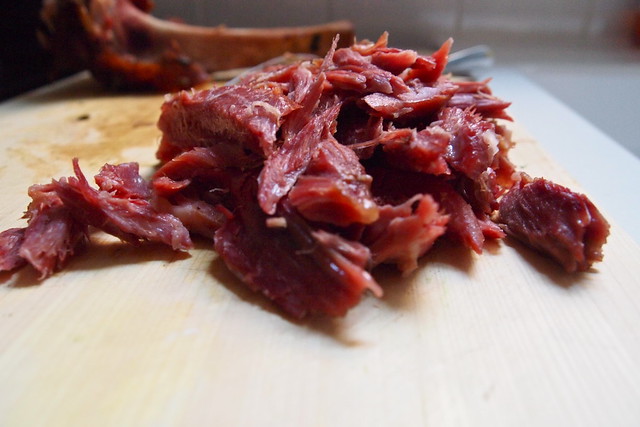
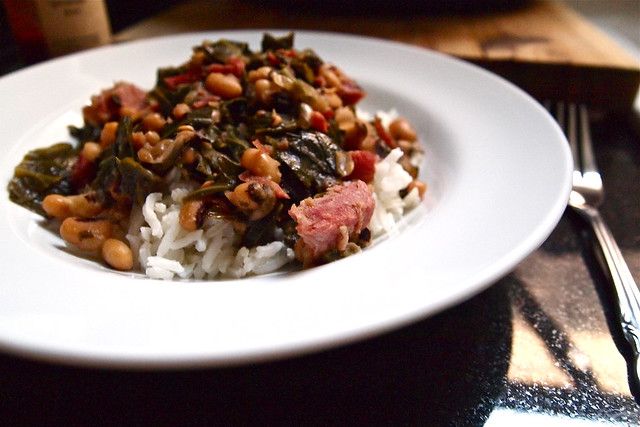
Smoked hock meat Hoppin' John collard stew
Pork and beans and greens might not exactly be your idea of how to start off the new year. But the smoked ham hock and the culinary tradition behind it--the resourcefulness of it, the ingeniousness of it--really appeal to me right now. These are ideas I can get behind, ideas I want to carry with me the  whole year through. And, if nothing else, who doesn't like a pile of silky collards, smoky meat, and creamy beans floating in porky broth on a cold winter's night? Just don't forget to bring your favourite hot sauce to the table too. Happy new year, everyone. 

Hoppin' John Collard Stew
From Kemp Minifie via Gourmet

1 medium onion, chopped
2 tablespoons vegetable oil
1/4 tsp hot red-pepper flakes
1 meaty smoked ham hock, about 1 lb in weight
10 cups water
1/2 lb / 1 1/4 cups dried black-eyed peas, picked over and rinsed (don’t soak)
1 lb collard greens, center ribs discarded and leaves chopped
Hot sauce to serve

Cook onion in oil with 1/2 tsp salt in a deep heavy medium pot over medium heat, stirring occasionally, until lightly browned, about 8 minutes. Add red-pepper flakes and cook, stirring, 1 minute. Add ham hock and water and simmer, partially covered, 1 hour. 
Add black-eyed peas and simmer, partially covered, 1 hour. 
Stir in collards (add water if necessary for a soupy consistency) and simmer, partially covered, stirring occasionally, until greens are very tender, 45 minutes to 1 hour. 
Remove ham hock and chop meat, discarding skin, fat, and bone. Stir into stew and thin with water, if necessary, then season with salt.
Serve over rice and with hot sauce at the table. The acidity of the hot sauce helps to cut through the rich smokiness of the stew.

Serves six.

Monday, December 19, 2011

Making do

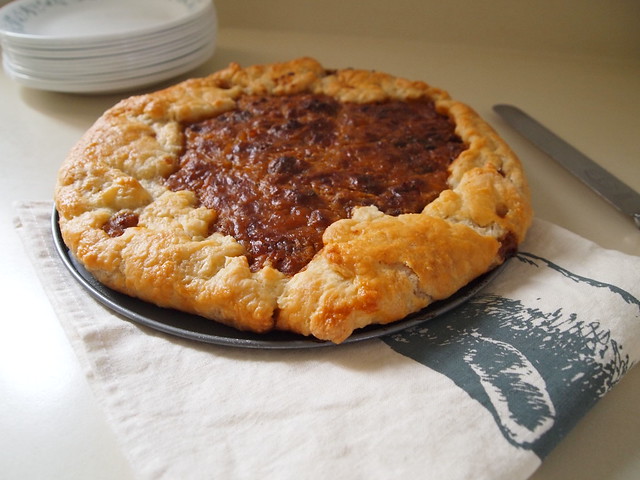
Caramelized onion and bacon galette
I don't tend to do much cooking when I'm away from home. People seem happy enough to feed me, and I'm a bit particular about where I cook anyway. I'll cook in someone else's kitchen if need be, of course, happily even, but that doesn't mean I won't chide you if your knives are dull or if you don't have any graduated measuring cups. I don't mind improvising, but I don't like surprises. So I tend to leave the cooking to others when I'm only visiting. I hope that's not too prima-donna-ish of me.
I make exceptions, of course, like this caramelized onion and bacon galette. I wasn't going to bother bringing anything to dinner with the extended family this past weekend. My grandmother was taking care of all the important things--the turkey, the stuffing, the pies---and I had been wrapped up in a blanket in front of the TV with a terrible cold for most of the week anyway. But by Saturday morning, I had pretty well recovered, and there were those onions and that bacon to consider--a little something from the very last issue of Gourmet that I'd rediscovered while convalescing.
My thoughts that morning, maybe still somewhat cold-addled, went something like this: a small mountain of onions cooked down until sweet, dark, and jammy! With bacon! And butter! Now, there's a reason to get out of bed! So I got out from under my heap of blankets, made some tea, and nudged my boyfriend toward that mountain of onions that would need chopping.
Now, the recipe as printed is actually for a Zwiebelkuchen, a sort of onion pie of German provenance, traditionally flavoured with bacon and caraway and bundled up in a yeasted crust. But I couldn't quite convince myself to proceed that way. My cold-addled daydreams of onion pie involved buttery, flaky pastry. Nothing less would do. It would happen--with or without a proper pastry blender. So, I turned to an old favourite, a butter-flecked galette dough, and didn't look back.
It paid off. The galette came together like a dream--the jammy onions made lush with sour cream and bacon drippings and baked bubbly and dark, the smoky, salty bacon to balance, all of it nestled in puffed and golden pastry. Not bad at all for having had to make do, I have to say (there were neither graduated measuring cups nor a pastry blender to be found anywhere at my parents' place).

Caramelized Onion and Bacon Galette
Adapted from Gourmet, November 2009 and Smitten Kitchen
Note: Extra filling. I had about a 1/4 cup or so of onion filling leftover that the pastry couldn't quite handle. I was in a bit of a hurry, so I eyed my 12 inches and didn't quite make a proper circle out of the dough. With more care, you might be able to get all of the filling in. If you can't manage it, not to worry. Just scoop the remaining filling into a ramekin and bake it alongside the galette. A few bites that you can set aside just for you. Caraway seeds. In keeping with the Zwiebelkuchen tradition, I think I might add at least a teaspoon of whole caraway seeds to the onions as they cook the next time I make this. I can see the caraway playing well with sweetness of the onions.

For the pastry:
1 1/4 cups all-purpose flour, chilled in the freezer for 30 minutes
1/4 teaspoon sea salt
8 tablespoons (1 stick) cold unsalted butter, cut into pieces and chilled again
1/4 cup sour cream
2 teaspoons fresh lemon juice
1/4 cup ice water
1 egg white + 1 teaspoon water

For the filling:
1/4 pound bacon, finely chopped
3 1/2 pounds onions, thinly sliced
4 tablespoons (1/2 stick) unsalted butter
1 cup sour cream
2 large egg yolks
Sea salt
Black pepper

Whisk together the flour and salt in a large bowl. Sprinkle bits of butter over dough and using a pastry blender, cut it in until the mixture resembles coarse meal, with the biggest pieces of butter the size of tiny peas. In a small bowl, whisk together the sour cream, lemon juice and water and add this to the butter-flour mixture. With your fingertips or a wooden spoon, mix in the liquid until large lumps form. Pat the lumps into a ball; do not overwork the dough. Cover with plastic wrap and refrigerate for 1 hour.
Meanwhile, cook the bacon over medium-high heat in a wide, heavy-bottomed pot or dutch oven until crisp. Then, add the onions, butter, 1 teaspoon of salt, and a few generous grinds of pepper to the pot. Give the onions a good stir to coat them evenly in bacon drippings and butter. Cook covered, stirring occasionally, until the onions have softened, 15-20 minutes. Remove the lid and cook, stirring occasionally, until the onions are deeply golden, another 20-30 minutes. Let cool. Whisk together the sour cream and egg yolks and then stir them into the onion mixture.
Preheat the oven to 375 degrees F. On a floured surface, roll out the dough into a 12-inch round. Lay the dough in the center of a half-sheet and spread the onion mixture over it in an even layer, leaving a 1 1/2-inch border all the way around. Fold the edges of the dough over the filling. Whisk together the egg white and water to make an egg wash. Brush an even layer over the dough. Bake the galette until the crust is golden brown and the filling is dark and bubbly, about 50-60 minutes. Serve warm or at room temperature.

Sunday, November 27, 2011

Traditions to stand by

Tartine Porchetta
The only thing traditional about Thanksgiving around here this year was the mashed potatoes. You'll have to excuse me. This was the first year in which I was in charge of everything, and I just didn't feel wedded to tradition. Maybe it has something to do with the fact that while growing up, my grandmother did it all--a twenty-pound bird, stuffing, mashed potatoes, three pies, the works. I didn't start contributing to holiday dinners until a few years ago, when I was a vegetarian. And back then, I put some decidedly non-traditional fare on the table alongside the turkey and sweet potatoes (French lentils with ricotta dumplings, this cauliflower cake). So, I guess the precedent was already set.
I envisioned a meal that would be a fun challenge for me to prepare, that would raise a few eyebrows around the table, and that would leave everyone full and happy at the end of the night. So, Thanksgiving for four went something like this:
  • roasted vegetable soup: delicata squash and fennel roasted with shallots, garlic, sage and rosemary, puréed with chicken stock and a touch of cream
  • Momofuku Ssäm Bar's brussels sprouts (which you can find here with Talley)
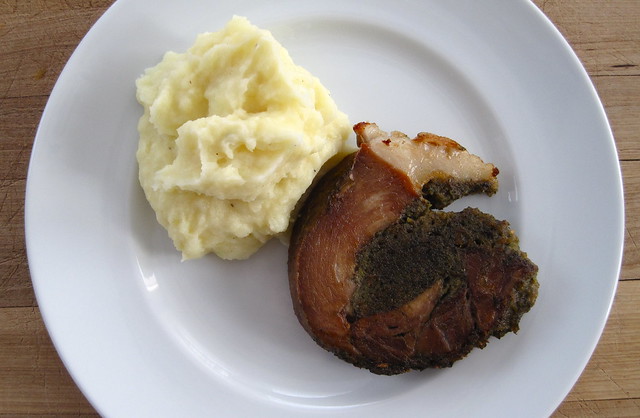
  • Thomas Keller's mashed potatoes (found here)
  • herb-stuffed porchetta from Tartine Bread
  • blue cheese and honey ice cream, thanks to The Perfect Scoop and a shiny new ice-cream maker (Yay! Also, here is a variation on the ice cream--not quite what's in the book)
A bit of an eclectic menu, I know, and rather pungent too--but it was great. We all ate more than we should have. We groaned getting up from the table. I may not be wedded to tradition when it comes to what we eat, but eating well, maybe too well, on Thanksgiving--now that's a tradition I stand by.
Leftovers are another of those things that make Thanksgiving what it is. For me as a kid, that meant a few days' worth of hot turkey sandwiches smothered in gravy and some stuffing on the side. This year, though, it's porchetta galore.
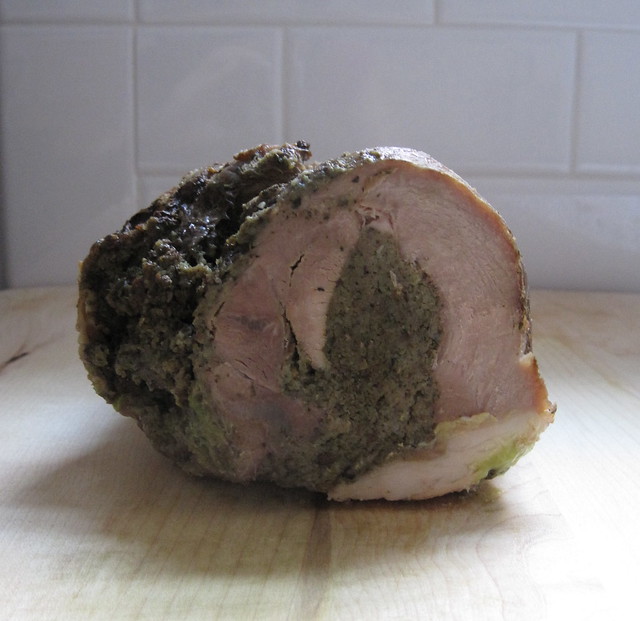
Let me explain. When I found out that I'd be hosting Thanksgiving, I was pretty convinced at the outset that I didn't want to do a turkey. A quick flip through Tartine Bread settled it. We were going to make the Tartine porchetta! Here's what you need to know. Slow-roasted pork shoulder. Butterflied and stuffed with sourdough breadcrumbs and a veritable bouquet of aromatics. Rolled up and trussed. Roasted for a solid eight hours, basting in its own fat and juices until unbelievably tender and fragrant. Sliced and pan-seared right before serving. Brilliant. Unfussy. As the book says, "...a regal way to cook a pork shoulder."
We went to The Butcher & Larder Wednesday afternoon and came home with our prized shoulder, fresh off a hog just delivered that day. We trimmed and stuffed and rolled, then let it roast into the night. My kitchen has never smelled so good at four in the morning.
Porchetta
I'm convinced. Holiday feasts and porchetta were made for one another. Roast your porchetta the night before, ease yourself into sweet, pork-filled dreams, wake up and tuck your roast into the fridge to rest, and you won't have to worry about it for the rest of the day. The oven will be free for whatever else you've got up your sleeve. When the time comes, give yourself a few minutes for slicing and a quick pan-sear, then call everyone to the table. Dig into some seriously good pork.
And then there's my favourite part. Unless you've got a crowd of 8 or 10 over, there will be leftovers in abundance. Think about the sandwiches. I can assure you. This porchetta, cold, thinly sliced, will be exactly what you want when you're all cooked-out in the aftermath.
Porchetta cross-cut
Porchetta
Adapted, just a little, from Tartine Bread
Note: Wrapping. It's important to wrap your porchetta in foil well to keep in the juices and fat. I didn't do quite as good a job as I should have, so the roast had a few dry spots. Don't let it happen to you! Make ahead. I think you can get away with roasting the porchetta 24-36 hours in advance. It will keep splendidly in the refrigerator on the sheet pan you baked it on, once cooled. Because of the long cooking time and the required resting period in the refrigerator, it would be very difficult to do everything day-of. The folks at Tartine recommend roasting it overnight, and that's more or less what I did. Stuffing. All of those herbs do wonders for the pork shoulder, but I found the stuffing itself a little too herbaceous. I'd consider adding some sautéed shallot or maybe even some grated apple to the mix next time.

5 pounds boneless pork shoulder
1 teaspoon sea salt

1 bunch flat-leaf parsley, stems removed
12 fresh sage leaves
1 tablespoon fresh rosemary leaves
2 tablespoons fresh thyme leaves
1 cup fennel fronds, chopped
1/4 teaspoon red pepper flakes
1 tablespoon fennel seeds
5 cloves garlic
2 teaspoons salt
4 slices day-old rustic sourdough, each about 1-inch thick, torn into small chunks
3-5 tablespoons olive oil

Have your butcher butterfly the pork shoulder to an even thickness of about 1 inch. You should have a long sheet of meat roughly 9 by 14 inches. Lay the pork shoulder out flat on a cutting board. Season with 1 teaspoon salt.
Preheat the oven to 220 degrees F.
To make the stuffing, in a food processor, combine the parsley, sage, rosemary, thyme, fennel fronds, red pepper flakes, fennel seeds, garlic, and salt, and pulse to chop. Add the bread and 3 tablespoons olive oil and pulse to combine. If the stuffing still looks a little dry still--the consistency should be almost spreadable and paste-like--add more olive oil and pulse again.
Spread the stuffing evenly over the surface of the meat. Beginning on one side, roll the meat up tight and secure with butcher's twine.
Place the roll on a sheet of aluminium foil. Fold the sides of the foil up and around both ends of the roast and then roll the roast to enclose it in foil. This helps retain the moisture and fat while the roast is cooking. Place the roast on a baking sheet and bake until the meat is very tender, 8 to 10 hours.
Leave the aluminium foil on the roast while it cools. Refrigerate for at least 2 hours to allow the roast to firm up and hold its shape.
Remove the roast from the foil and cut off the twine. Cut the roast crosswise into slices about 1-inch thick. Heat a heavy skillet over medium heat. When the skillet is hot, add enough olive oil to cover the bottom of the pan, and add as many slices of porchetta as will fit in the pan. Cook the slices until brown, 3 to 5 minutes. Turn and cook until browned on the second side and heated through, 2 to 4 minutes. Serve.
Serves 8-10.