Things have been a little crazy around here lately. I've started a teaching-assistantship and find the dance of students' pens across paper as I speak a little disconcerting. I'm just not used to having anything I say aloud seem important enough for people to be taking notes. And I've been putting together my dissertation committee, which has also been a little terrifying. See, the dissertation, up until about now, hasn't been much more than a mythical beast. Sure, you start grad school knowing that this is what it all leads up to, writing a small book's worth of sound and original ideas, meticulously argued for. And, sure, you see the people around you, very smart people, muddling through. But, for you, it remains just a smudge on the horizon, like, when you were much younger, the prospect of growing up and leaving home--something you knew you would have to do someday but that for the time being was pretty well unfathomable. And so you're able to assure yourself that when you get there, you'll be ready. You'll be so much better read. You'll have it all figured out. And then one day, you wake up to find that you don't know where the days went, that you still don't feel quite ready, but that someday is now, the very day stretching before you. Like I said, a little terrifying. But a little exhilarating too.

In this way, starting to work on a dissertation is, I imagine, a lot like some of life's other milestones, the ones that we know to expect but never really feel ready for. Like turning 30. I'm not there yet, but a good friend of mine is as of this week. And leading up to it, he was, as far as I could tell, fine with it. But either way, I thought that he might appreciate a few macarons.
For this, I turned to Pierre Hermé's Macaron. I've had a copy for almost two years now (thanks to my friend whose birthday it was, incidentally), and working from it is still for me as daunting, as exhilarating as ever. This, admittedly, has something to do with the fact that I don't make macarons very often. Pastry bag in hand, I always feel like I'm at least a little out of practice. But this aside, making macarons from this book for me always has the feel of something like a high-wire act. You put a lot in at the outset--blanching and grinding almonds to a fine powder, aging egg whites, making ganache, and, in this case, candying some lemon peel--but then it all comes down to just a few moments in the process, and there's the sense that it'd be all too easy to misstep.
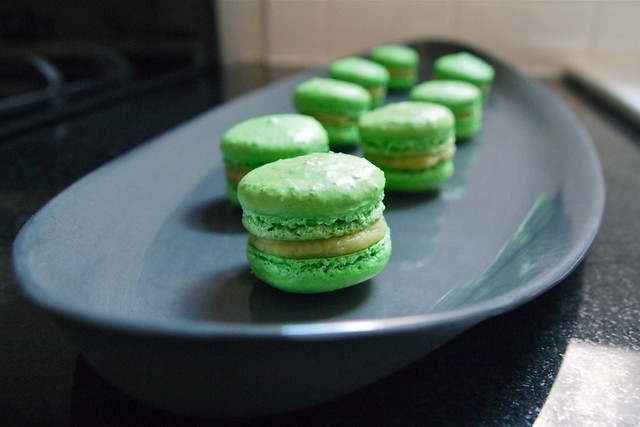
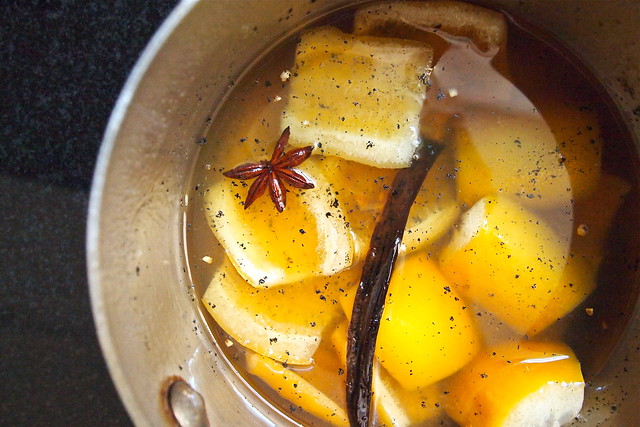
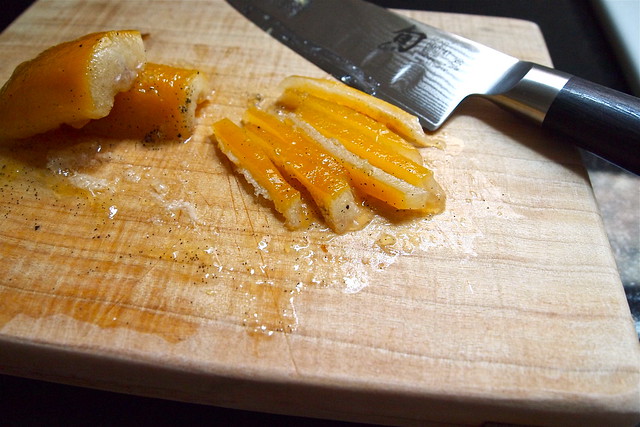
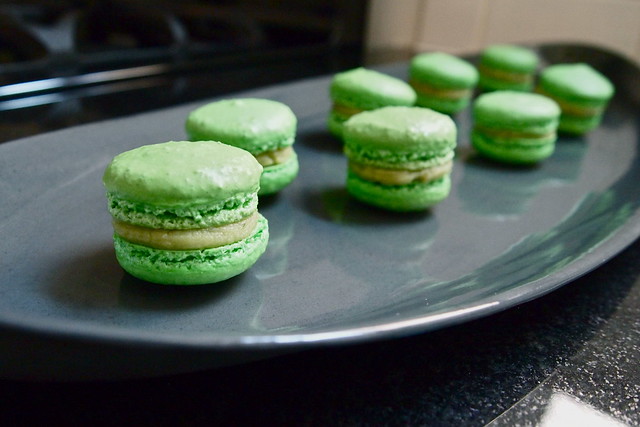
So why do it at all? It's not for everyone, admittedly. But I like the challenge. I like the constraints. On that narrow a wire, you only find ways to get better at what you're doing. You make strides. And, in particular, this time around, I just really wanted to know what a macaron avocat-citron would taste like. The avocat part is the ganache--mashed avocado whisked bit by bit into cream and melted white chocolate, then chilled until it attains a luxurious thickness. The citron part is candied lemon peel--bright little gems cooked with vanilla bean, star anise, and sarawak peppercorn, at the centre of each macaron. The overall effect is something marvellous, multidimensional. It starts with the avocado, whose presence is quiet and vegetal, adding a certain softness to the sweetness of the ganache. Then comes the pop of the candied peel--citrusy, bitter, floral. And like any good macaron, it has a way of almost disappearing before you know it, leaving behind just a few bright green shards of shell.
At my friend's party--a sprawling, unhurried sort of Sunday brunch--the conversation at one point turned to what it's like being in your thirties (most of the other attendees were already there). Another friend offered up the following insight--that what was important when turning 30 wasn't so much having everything figured out but being in a good place. And with friends, mimosas, and macarons abound, my friend, I thought, wasn't off to a bad start.
I don't pretend to be a macaron expert. Like I said, I don't make them nearly often enough. (And it shows!) So, if you're looking for pointers, Not So Humble Pie is a good place to start.
I don't pretend to be a macaron expert. Like I said, I don't make them nearly often enough. (And it shows!) So, if you're looking for pointers, Not So Humble Pie is a good place to start.
Macaron Avocat-Citron
Adapted from Pierre Hermé's Macaron
Special equipment: scale, candy thermometer, stand mixer, pastry bags, no. 11 piping tip. About the aged egg whites. Hermé recommends that a week before you plan to make the macarons you separate the requisite amount of egg white from the yolks and age them in the fridge. Place them in a small container, cover it with plastic wrap, and puncture the plastic a few times with a sharp knife. After four to seven days in the fridge, the whites will lose their elasticity, making them easier to whip up and less likely to get over-beaten and dry. About the couverture chocolate. By definition, couverture chocolate is chocolate that is at least 32% cocoa butter. For the first time this time, I had some Valrhona Ivoire on hand. I can't say definitively whether it was the Valrhona, but this ganache set up far more nicely than the last Hermé ganache I made with Callebaut. About the food colouring: I've been using this set from Williams-Sonoma for my last few batches of macarons. The colours are pretty limited, but I haven't been dedicated enough to track down a fancier line.
CANDIED LEMON
4 lemons, preferably organic
500 ml water
250 g granulated sugar
1 star anise
5 black sarawak peppercorns
1/2 vanilla bean
2 tablespoons lemon juice
MACARON SHELLS
150 g finely blanched and ground almonds
150 g powdered sugar
55 g aged egg whites
1 g lemon-yellow food colouring
2 g pistachio-green food colouring
+
150 g granulated sugar
38 g water
55 g aged egg whites
AVOCADO-LEMON GANACHE
1-2 ripe avocados
25 g lemon juice
Pinch of sea salt
50 g heavy cream
Zest of a quarter lemon
250 g couverture white chocolate, preferably Valrhona
DAY ONE: Bring a medium pot of water to a boil. In the meantime, rinse and dry the lemons. With a sharp knife, trim the ends and cut off the skin from top to bottom in strips, taking a good centimeter of lemon flesh with them. Put the strips in the water, return to a boil, and cook for 2 minutes then drain. Repeat this blanching process two more times with fresh water each time.
Crush the peppercorns. Place them in a medium saucepan along with the water, sugar, lemon juice, and star anise. Split the half vanilla bean in two along its length and scrape the seeds into the pan. Add the empty pod. Bring the mixture to a boil over low heat. Add the lemon strips. Simmer gently on medium-low for about one and a half hours, partially covered. Pour the zests and syrup into a bowl and let cool. Cover the bowl with plastic wrap and leave in the refrigerator until the following day.
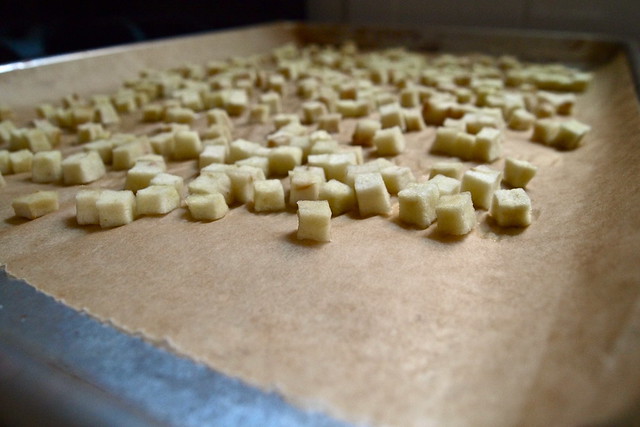
DAY TWO: Place the candied lemon in a strainer over a bowl and let drain for about 1 hour. Then cut to a 3mm dice.
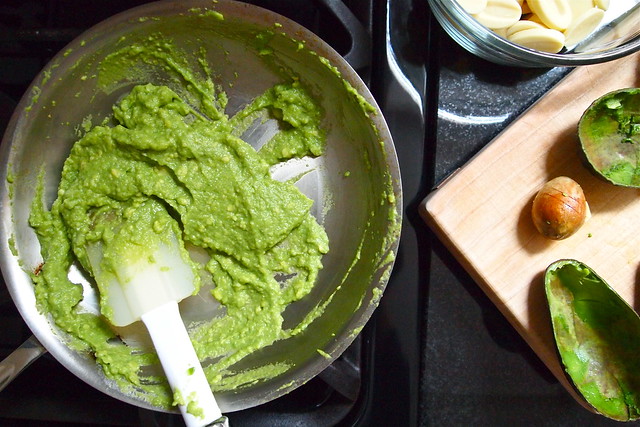
Meanwhile, prepare the ganache. Cut the avocados in two and remove their pits. Scoop out the flesh with a spoon and mash. Weigh 150 g of mashed avocado (set aside the remaining for another use) and stir in the lemon juice and salt. Heat the avocado in a small saucepan over a very low flame. Stir continuously until the purée reaches 40-50 degrees C / 104-122 degrees F. Remove from heat.
Unless using féves, give the chocolate a rough chop. Put the chocolate in a heat-proof bowl over a pot of simmering water to melt. Stir occasionally. In a small saucepan, bring the cream to a boil and add the lemon zest. Pour the cream over the chocolate and then begin adding the avocado purée, a little bit at a time. Whisk vigorously to prevent the ganache from breaking. Once the avocado is fully incorporated, pour the ganache into a wide heat-proof dish and cover with plastic wrap, touching it to the surface of the ganache to prevent a skin from forming. Chill in the refrigerator until thick and creamy, 3-4 hours.
Prepare the macaron shells. Sift the ground almonds and powered sugar into a large bowl. Stir together the food colouring and one 55 g portion of egg whites in a small dish. Add these to the almonds and sugar but do not mix them in.
In a small saucepan, bring the granulated sugar and water to a boil. Keep the sides of the saucepan clean to prevent the sugar from re-crystallising by brushing them with a wet pastry brush. When the syrup reaches 110 degrees C / 230 degrees F, begin whipping the second 55 g portion of egg whites using a stand mixer. When the syrup reaches 118 degrees C / 244 degrees F, slowly pour the syrup into the whites, letting the syrup run down the sides of the bowl so that it doesn't splatter. The whites should have barely formed soft peaks at this point. Continue whipping the whites on high speed for one more minute. Reduce the speed of the mixer to medium and continue whipping the whites for about 2 minutes. The whites are ready when they've cooled to 50 degrees C / 122 degrees F. Add the whites to the powdered almond mixture and fold in, running your spatula under the mixture and turning it over onto itself. Continue working the batter in this way until it reaches the right consistency. It will be the right consistency when it falls off the end of the spatula in a thick ribbon and sinks into the batter in the bowl. If the batter holds its shape, it needs to be worked for longer. Batter with this consistency won't produce smooth shells.
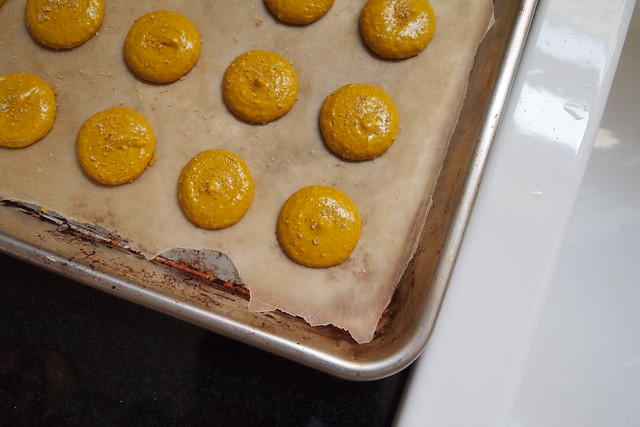
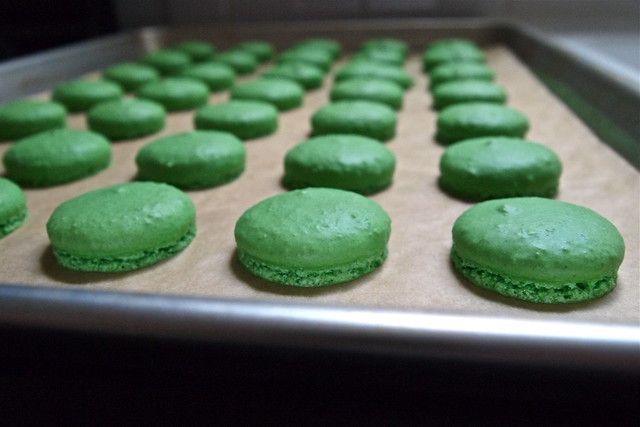
Put the macaron batter in a pastry bag fitted with a no. 11 tip. Pipe shells around 3.5 cm in diameter, spaced at least 2 cm apart on a parchment-lined half-sheet (doubled with another half-sheet for insulation). Let the shells stand for 30 minutes, and meanwhile, preheat the oven to 180 degrees C / 356 degrees F. Bake the shells for 12-14 minutes. Let the shells cool for at least 30 minutes before lifting them from the parchment.
Assemble the macarons. Fill a pastry bag fitted with a no. 11 tip with the avocado. Pipe a generous amount of ganache on half of the macaron shells. Add three or four candied lemon cubes to each ganache-topped shell. Sandwich these with the remaining shells. Leave the macarons in the refrigerator for 24 hours. Remove from the refrigerator 2 hours before serving.
Makes about 36 macarons.
4 lemons, preferably organic
500 ml water
250 g granulated sugar
1 star anise
5 black sarawak peppercorns
1/2 vanilla bean
2 tablespoons lemon juice
MACARON SHELLS
150 g finely blanched and ground almonds
150 g powdered sugar
55 g aged egg whites
1 g lemon-yellow food colouring
2 g pistachio-green food colouring
+
150 g granulated sugar
38 g water
55 g aged egg whites
AVOCADO-LEMON GANACHE
1-2 ripe avocados
25 g lemon juice
Pinch of sea salt
50 g heavy cream
Zest of a quarter lemon
250 g couverture white chocolate, preferably Valrhona
DAY ONE: Bring a medium pot of water to a boil. In the meantime, rinse and dry the lemons. With a sharp knife, trim the ends and cut off the skin from top to bottom in strips, taking a good centimeter of lemon flesh with them. Put the strips in the water, return to a boil, and cook for 2 minutes then drain. Repeat this blanching process two more times with fresh water each time.
Crush the peppercorns. Place them in a medium saucepan along with the water, sugar, lemon juice, and star anise. Split the half vanilla bean in two along its length and scrape the seeds into the pan. Add the empty pod. Bring the mixture to a boil over low heat. Add the lemon strips. Simmer gently on medium-low for about one and a half hours, partially covered. Pour the zests and syrup into a bowl and let cool. Cover the bowl with plastic wrap and leave in the refrigerator until the following day.
DAY TWO: Place the candied lemon in a strainer over a bowl and let drain for about 1 hour. Then cut to a 3mm dice.
Meanwhile, prepare the ganache. Cut the avocados in two and remove their pits. Scoop out the flesh with a spoon and mash. Weigh 150 g of mashed avocado (set aside the remaining for another use) and stir in the lemon juice and salt. Heat the avocado in a small saucepan over a very low flame. Stir continuously until the purée reaches 40-50 degrees C / 104-122 degrees F. Remove from heat.
Unless using féves, give the chocolate a rough chop. Put the chocolate in a heat-proof bowl over a pot of simmering water to melt. Stir occasionally. In a small saucepan, bring the cream to a boil and add the lemon zest. Pour the cream over the chocolate and then begin adding the avocado purée, a little bit at a time. Whisk vigorously to prevent the ganache from breaking. Once the avocado is fully incorporated, pour the ganache into a wide heat-proof dish and cover with plastic wrap, touching it to the surface of the ganache to prevent a skin from forming. Chill in the refrigerator until thick and creamy, 3-4 hours.
Prepare the macaron shells. Sift the ground almonds and powered sugar into a large bowl. Stir together the food colouring and one 55 g portion of egg whites in a small dish. Add these to the almonds and sugar but do not mix them in.
In a small saucepan, bring the granulated sugar and water to a boil. Keep the sides of the saucepan clean to prevent the sugar from re-crystallising by brushing them with a wet pastry brush. When the syrup reaches 110 degrees C / 230 degrees F, begin whipping the second 55 g portion of egg whites using a stand mixer. When the syrup reaches 118 degrees C / 244 degrees F, slowly pour the syrup into the whites, letting the syrup run down the sides of the bowl so that it doesn't splatter. The whites should have barely formed soft peaks at this point. Continue whipping the whites on high speed for one more minute. Reduce the speed of the mixer to medium and continue whipping the whites for about 2 minutes. The whites are ready when they've cooled to 50 degrees C / 122 degrees F. Add the whites to the powdered almond mixture and fold in, running your spatula under the mixture and turning it over onto itself. Continue working the batter in this way until it reaches the right consistency. It will be the right consistency when it falls off the end of the spatula in a thick ribbon and sinks into the batter in the bowl. If the batter holds its shape, it needs to be worked for longer. Batter with this consistency won't produce smooth shells.
Put the macaron batter in a pastry bag fitted with a no. 11 tip. Pipe shells around 3.5 cm in diameter, spaced at least 2 cm apart on a parchment-lined half-sheet (doubled with another half-sheet for insulation). Let the shells stand for 30 minutes, and meanwhile, preheat the oven to 180 degrees C / 356 degrees F. Bake the shells for 12-14 minutes. Let the shells cool for at least 30 minutes before lifting them from the parchment.
Assemble the macarons. Fill a pastry bag fitted with a no. 11 tip with the avocado. Pipe a generous amount of ganache on half of the macaron shells. Add three or four candied lemon cubes to each ganache-topped shell. Sandwich these with the remaining shells. Leave the macarons in the refrigerator for 24 hours. Remove from the refrigerator 2 hours before serving.
Makes about 36 macarons.